


The lowest-cost option can be the least reliable. When sourcing hard to find research reagents, first match the reagent to your experiment, then assess supplier reputation, quality controls, batch traceability and purity. Also consider stability, storage, solubility, handling and delivery conditions.
An uncommon reagent can hold up a carefully planned workflow, and a familiar product name alone does not show whether it suits your method. Assess the available evidence and practical requirements instead of treating availability as the only test.
This guide explains how to assess supplier reputation, Certificates of Analysis and batch records, then consider stability, storage, solubility and handling. It also shows how to compare reagent options with published methods and your laboratory’s needs, helping you make an informed sourcing decision in Australia.
Key Takeaways
- Assess supplier reputation alongside quality controls, batch records and available Certificates of Analysis, not price alone.
- Match storage, stability, solubility and handling requirements to your laboratory setup before selecting a reagent.
- Use published methods and your experimental needs to narrow down suitable alternatives when a specific reagent is difficult to source.
- For Australian research sourcing, OZZ Peptides offers research reagents and laboratory compounds, including custom research product sourcing.
1. Manufacturer reputation and quality control
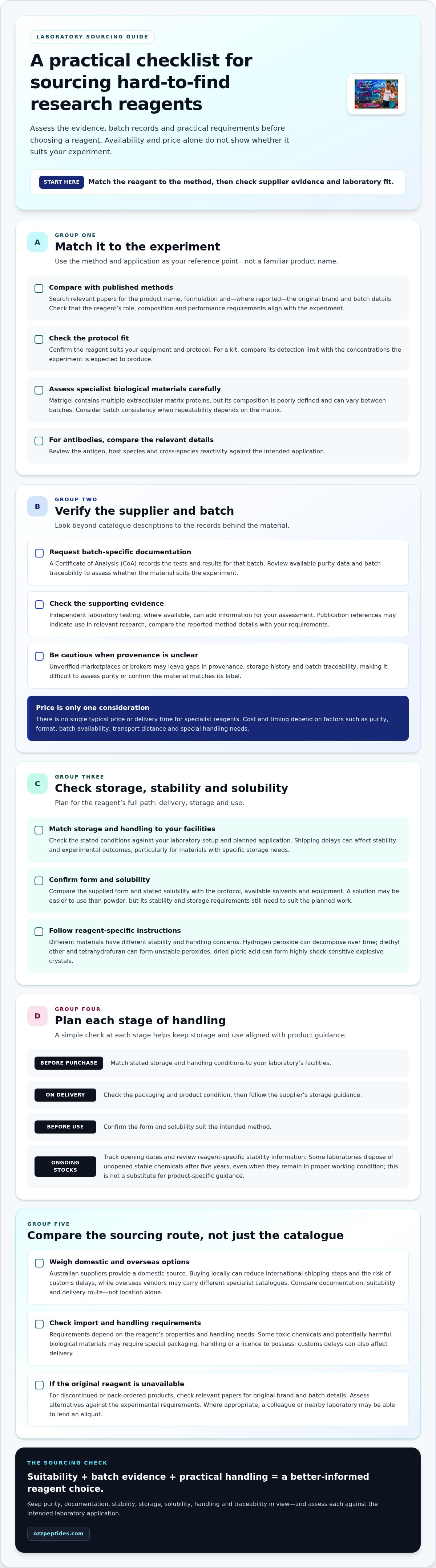
Start with the supplier’s quality records, not just the catalogue description. Look for a batch-specific Certificate of Analysis (CoA), which records the tests and results for that batch. Independent laboratory testing, purity data and traceability help you assess whether the material suits your experiment. Publication references can indicate whether the reagent has been used in relevant research. Compare product details with methods sections, including the brand and batch where reported.
Australian suppliers provide a domestic source, while overseas vendors may carry different specialist catalogues. Buying domestically can reduce international shipping steps and the risk of customs delays. Compare options by documentation, suitability and delivery route, not location alone.
Import requirements depend on a reagent’s properties and how it must be handled. Some toxic chemicals and potentially harmful biological materials may require special packaging, handling or a licence to possess. Customs delays can also affect delivery.
There is no single typical price or delivery time for specialist reagents. Cost and timing depend on factors such as purity, format, batch availability, transport distance and special handling needs.
For rare reagents in Australia, look for suppliers focused on research materials and custom sourcing. A suitable supplier can provide clear batch documentation and information to help assess whether a product fits the intended laboratory application.
For discontinued or back-ordered reagents, search relevant papers’ methods sections for the original brand and batch details. Compare alternatives with the experimental requirements, and consider whether a colleague or nearby laboratory can lend an aliquot.
Unverified marketplaces and brokers may leave gaps in provenance, storage history and batch traceability. Without reliable documentation, you may be unable to assess purity or confirm that the material matches its label.
To find alternatives, compare the reagent’s role, composition and performance requirements with published methods. For antibodies, review the antigen, host species and cross-species reactivity. For kits, match the detection limit to the concentrations your experiment is expected to produce. Then check that the alternative suits your equipment and protocol.
2. Stability, storage, solubility and handling
A reagent’s label is only part of the decision. Check its storage conditions, expected stability, solubility and handling requirements against your laboratory’s facilities and planned applications. These factors affect suitability from delivery through use. Shipping delays can also affect stability and experimental outcomes, especially for products with specific storage needs.
Consider the chemistry, not just the container. Hydrogen peroxide can decompose into water and oxygen over time, potentially causing false negatives and wasted experiments. Diethyl ether and tetrahydrofuran can form unstable peroxides through reactions with atmospheric oxygen. Picric acid presents a different risk: if it dries out during storage, it can form highly shock-sensitive explosive crystals. These examples show why reagent-specific instructions matter.
Solubility matters in practice. A compound that dissolves poorly in the chosen solvent may not suit the method or experimental setup. Before ordering, compare the stated solubility and supplied form with the protocol, available solvents and equipment. A reagent supplied in solution can be easier to use than powder, but its stability and storage requirements must still suit the planned work.
- Before purchase: Match the stated storage and handling conditions to your laboratory’s facilities.
- On delivery: Check the packaging and product condition, then follow the supplier’s storage guidance.
- Before use: Confirm the reagent’s form and solubility suit the intended method.
- For ongoing stocks: Track opening dates and review reagent-specific stability information. Some laboratories dispose of unopened stable chemicals after five years, even when they remain in proper working condition; that practice is not a substitute for product-specific guidance.
For laboratory research, these checks help determine whether a product is useful for the intended experiment and manageable with existing facilities. Explore research compounds for laboratory applications with those practical requirements in mind.
Select reagents based on purity, batch documentation, stability, storage, solubility, handling, traceability and suitability for the intended application. These criteria keep your choices aligned with the planned work and laboratory needs.
If an experiment can be delayed, researchers may be able to freeze the cells of interest and resurrect them later. Consider this option when planning the work and selecting suitable reagents.
3. Which research reagents are hardest to source in Australia?
In Australia, sourcing difficulties often come down to a reagent’s specificity, documentation and supply route. When sourcing hard to find research reagents, start with published methods and search for the exact product name, formulation and batch details. Compare alternatives with the original experimental requirements rather than relying on a similar-sounding catalogue description.
Specialist biological materials can add complexity. Matrigel contains multiple extracellular matrix proteins, but its composition is poorly defined and can vary between batches. Batch consistency therefore matters for experiments that rely on a repeatable matrix. Antibody selection also depends on product details, so compare the intended application with information about the antigen sample, host species and cross-species reactivity.
Assay kits can be unsuitable even when their names seem relevant. For example, an ELISA kit with a nanomolar detection limit will not suit an experiment expected to produce picomolar concentrations. Check the detection range against the expected signal before ordering. This can rule out a product that cannot answer the research question.
Chemistry researchers may need a specific synthesis reagent rather than a broad substitute. Tollens’ reagent is an aqueous mixture of silver nitrate, ammonia and a little sodium hydroxide used to identify aldehydes. The Tebbe reagent converts carbonyl compounds into methylene compounds. These examples show why a compound’s role in a reaction matters as much as its name.
- For biological models: Compare matrix batch information with the experimental requirements.
- For antibodies: Match the reagent to the target, sample and intended application.
- For assay kits: Check the detection limit against the expected concentration.
- For specialist chemistry: Search papers for the exact reagent and reaction, then assess alternatives against the method.
When hard to find research reagents are central to a protocol, these checks help distinguish a suitable equivalent from a product that merely sounds similar. They also give Australian laboratories a clearer basis for deciding whether to source the original, adapt the method or plan a different experiment.
4. What causes research reagents to be difficult to find or buy?
Research reagent supply can tighten when demand rises faster than production. During the pandemic, laboratory shortages affected gloves, pipette tips and reagents. Demand for materials used in SARS-CoV-2 research and testing also made supplies harder to obtain. For Australian teams, a missing reagent can disrupt planned work, particularly when other steps depend on its arrival.
Specialist products may have a narrow supply base. A reagent designed for a specific method may have few suitable equivalents, while specialised manufacturing can limit how quickly supply responds to demand. If an item is back-ordered, compare alternatives with the research question and experimental requirements. A substitute that changes the method may also change what the experiment can establish.
International sourcing adds practical steps for Australian laboratories. Overseas transport can involve extra handling, and customs delays may affect shipments that require special packaging. Toxic chemicals and potentially harmful biological materials may require special packaging, handling and a licence to possess. These factors can make an order more complex than a routine laboratory consumable.
Supply interruptions can also constrain troubleshooting. Without a required material, researchers may be unable to compare products or test different conditions promptly. A delay can affect optimisation as well as the planned experiment. Identifying critical reagents early gives teams more time to plan around supplier back-orders.
Build a sourcing plan around the experiment's essential requirements. Record which materials have no practical substitute, review supply status during planning and decide whether another kit or method could still address the research question. If a delay is short, postponing the experiment may be more practical than changing the protocol. For a suitable research compound, compare options in the research range as part of that planning.
Demand for reagents and other laboratory materials used in SARS-CoV-2 research and testing made them difficult for researchers to obtain. During the pandemic, researchers also faced backorders of laboratory supplies, including gloves, pipette tips and reagents. These shortages affected several types of materials at once, making it harder to keep research work supplied.
Geography can add another obstacle. A sizable chemistry department in a remote Australian regional area can be about 160 kilometres away from the nearest metropolitan university chemistry department and from major chemical vendors. Such distance can make access to suppliers a particular concern for regional and remote research teams.
OZZ Peptides: Research Peptides
OZZ Peptides supplies Research Peptides, Research Reagents, Laboratory Research Compounds and Research-Grade Peptides for scientific and laboratory research. For Australian laboratories seeking a research compound, the catalogue is a practical starting point for comparing options with study requirements. Products come with third-party Certificates of Analysis, which help researchers review batch information when making sourcing decisions.
These compounds are for laboratory research only, not human consumption or medical treatment. Match each product to your protocol, quality requirements and handling procedures before use.
For research compounds suited to your laboratory work, visit the OZZ Peptides research shop.
Move your sourcing plan forward
Turn your sourcing decision into a clear record for your research team. Document why a reagent or alternative suits the study, and keep that rationale with the protocol. This makes future orders and method changes easier to manage if a supplier’s catalogue changes.
For Australian laboratories sourcing hard to find research reagents, OZZ Peptides supplies Research Peptides, Research Reagents and Laboratory Research Compounds for laboratory research. Choose products according to your study requirements and intended application. These compounds are for laboratory research only, not human consumption or medical treatment.
Take the next step by exploring the available research range and identifying options that fit your work.
A considered sourcing plan helps your team move ahead with greater clarity.
Frequently Asked Questions
How can researchers verify the quality, purity, and authenticity of rare reagents?
Match the container’s batch or lot identifier to its Certificate of Analysis, then compare the stated compound identity and purity results. Confirm that the report names the same product and batch, and review the analytical method used. For added assurance, validate the document with the manufacturer through its official channel. OZZ Peptides provides Certificates of Analysis for research products.
What are typical prices and delivery times for specialty research reagents in Australia?
There is no single typical price or delivery time. Both depend on purity, format, batch availability, transport distance and special handling needs.
Disclaimer
Research Information Disclaimer
The information provided in this article is intended solely for general educational and scientific research purposes.
OZZ Peptides supplies laboratory research compounds and reagents for legitimate research applications only. Products labelled for research use are not intended for human or veterinary consumption, injection, diagnosis, treatment or prevention of disease.
Information about experimental compounds, scientific studies or preliminary research findings should not be interpreted as medical advice or evidence of regulatory approval.
Scientific findings may be preliminary, and research outcomes are not guaranteed.
Readers should consult appropriately qualified professionals and applicable Australian regulatory guidance before undertaking relevant research activities.