


Custom products start with a clear specification, not a factory catalogue. Custom research product sourcing means defining what you need, identifying manufacturers that can meet those requirements, then comparing their capabilities, terms and sample quality before committing to production. The sample stage matters: it lets you assess whether a product matches the agreed requirements.
A quoted unit price alone won’t show whether a supplier is the right fit. Consider product specifications, available quality documentation, ordering terms and delivery arrangements. A practical evaluation process helps you compare suppliers against the same criteria.
This guide explains product sourcing, how to approach manufacturers about custom products, and what to consider when reviewing samples. It also covers research-focused sourcing in Australia, helping you move from an initial requirement to a more informed supplier decision.
Key Takeaways
- Product sourcing covers finding, assessing and acquiring products, with supplier choice shaped by your specifications and business needs.
- Approach manufacturers with a clear product brief, then compare their capabilities, terms and production requirements before choosing a supplier.
- Use samples to assess whether a product matches your specifications, and consider supplier reliability alongside quality.
- For laboratory research needs, understand how a specialist supplier’s research compounds fit your requirements before selecting products.
1. What is product sourcing?
Product sourcing is the process of finding, evaluating and acquiring goods for a business. It can involve researching suppliers, comparing terms, arranging logistics and reviewing product quality. A business might source ready-made stock from a wholesaler or work directly with a factory to develop a custom product. The right route depends on the specification, demand and supply requirements.
Related terms describe different parts of the process. Procurement research gathers information about suppliers, products and market conditions to guide purchasing decisions. A sourcing strategy sets criteria for selecting suppliers and managing supply. Category definition clarifies which products belong in the group being assessed. Technology maturity describes how developed a product or production method is, from an early prototype to an established manufacturing process.
For a practical overview of researching and assessing manufacturers, watch this video:
For custom research product sourcing, define the category before approaching suppliers. For example, distinguish a laboratory reagent from a finished consumer product. Then document the intended research use, required characteristics and quality checks. These details help manufacturers assess whether their capabilities match your request and make supplier comparisons more consistent.
For Australian imports, duties and GST depend on the goods and transaction. Include shipping, duties and taxes when comparing total sourcing costs, rather than relying on the quoted product price alone.
Certifications and product safety standards vary by product category and intended use. Identify the requirements relevant to the product, then request applicable certificates and technical documentation from the manufacturer as part of supplier assessment.
To assess ethical and sustainable suppliers, set clear criteria for labour practices, materials, traceability and environmental impacts. Ask manufacturers for evidence against those criteria, then compare it alongside product quality and delivery capability.
For Australian public-sector opportunities, AusTender is the Australian Government’s procurement information system and includes construction-related contracts and opportunities.
2. Direct manufacturer sourcing for custom products
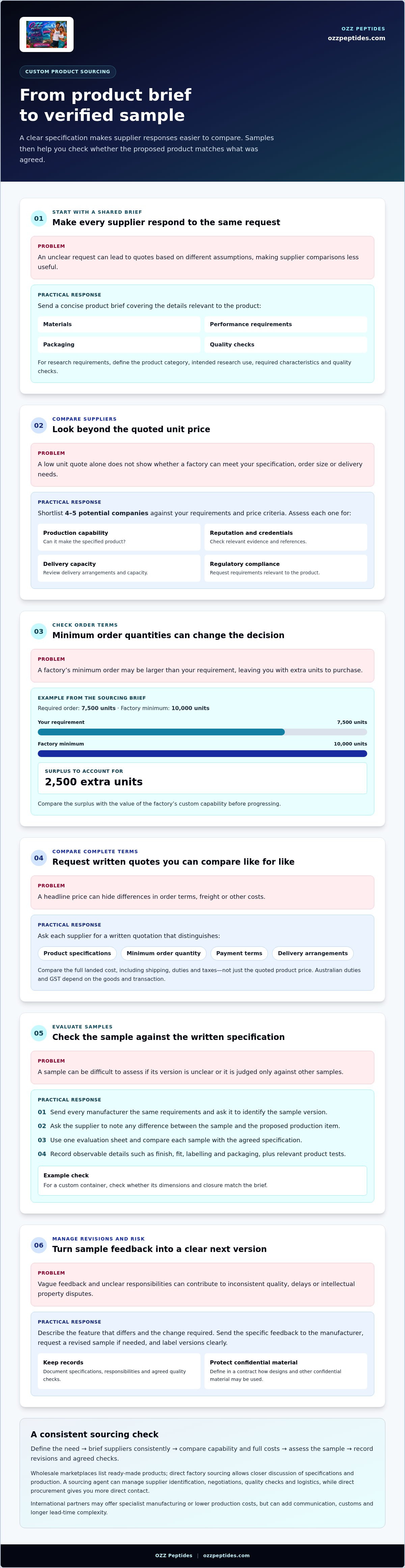
Direct sourcing means working with a factory to make a product to your specification. Start with a concise brief covering materials, performance requirements, packaging and quality checks. Then identify manufacturers whose capabilities match those needs. A clear brief ensures each supplier responds to the same request, making comparisons more useful.
Shortlist 4-5 potential companies against your requirements and price criteria. Assess their production capability, reputation, delivery capacity, credentials and regulatory compliance. Ask for written quotations that distinguish product specifications, minimum order quantities, payment terms and delivery arrangements. Keep those details together so you can compare like with like.
Minimum order quantities can change the economics of a custom run. If your requirement is 7,500 units and a factory’s minimum is 10,000, you would need to purchase 2,500 extra units. Compare that surplus with the value of the factory’s custom capability before progressing. International partners may offer specialist manufacturing or lower production costs, but communication, customs and longer lead times add complexity.
Wholesale marketplaces list ready-made products from sellers, while direct factory sourcing allows closer discussions about specifications and production. A sourcing agent can handle supplier identification, negotiations, quality checks and logistics on your behalf. Direct procurement gives you more direct contact; an intermediary can manage parts of the process.
There’s no single Australian cost for custom sourcing. Your total depends on product specifications, production volume, minimum order quantities, sourcing service fees, shipping, duties and taxes. Compare the full landed cost, not just the quoted unit price.
Key risks include supplier fraud, delays, inconsistent quality and intellectual property disputes. Vet suppliers, document specifications and responsibilities in a contract, and define how designs or other confidential material may be used. Clear records and agreed quality checks help manage supply-chain issues.
For laboratory research requirements, compare your specification with relevant research products as you plan the sourcing brief.
3. Requesting and evaluating product samples
A sample lets you inspect a product against its written specification before placing a larger order. Send each manufacturer the same requirements, including materials, dimensions, performance criteria, packaging and required documentation. Ask the supplier to identify the sample version and note any differences from the proposed production item.
Australian businesses can assess suppliers by reviewing their business identity, manufacturing capability, references and relevant credentials. Evaluate product quality through samples and documented checks. For international sourcing, a third-party inspection can provide an additional assessment of the goods.
Use the same evaluation sheet for every sample. Compare each item with the agreed specification, not just with other samples. Record observable features such as finish, fit, labelling and packaging, then note any relevant product tests. For a custom container, for example, check whether its dimensions and closure match the brief.
Keep feedback specific and actionable. Instead of writing “quality needs improvement”, identify the feature that differs and the change required. Send that feedback to the manufacturer and request a revised sample if the specification needs adjustment. Label versions clearly so purchasing decisions refer to the correct sample.
Market research can show whether a design meets buyer expectations, while sample evaluation checks whether the actual item meets technical requirements. These are different questions. A competitive product may attract interest, but the sample still needs to match its stated specification before production proceeds.
Consider the supply chain as well as the sample. Ask how the supplier will maintain the approved specification during production, document quality checks and manage changes to materials or processes. A sample alone doesn’t establish that later inventory will match it.
For laboratory research materials, assess product identity and relevant analytical documentation against your research specification. A Certificate of Analysis can provide product-specific test information for review alongside the sample and supplier records.
Make the decision traceable by retaining the approved specification, sample notes, supplier responses and final acceptance record. This paper trail gives your team a clear reference if production questions arise.
4. Which Australian companies offer custom product sourcing and research services?
In Australia, custom product sourcing may involve specialist sourcing firms, manufacturers or suppliers focused on a particular category. Their roles differ. A sourcing firm can coordinate supplier vetting, negotiations, quality checks and logistics; a manufacturer produces goods; a research supplier provides products for defined laboratory work.
Choose the provider type that matches the task. For a custom consumer product, a sourcing firm may help identify factories and manage communication. For a product with a defined technical specification, approaching a suitable manufacturer directly can keep production discussions close to the source. For laboratory research materials, a specialist supplier is more relevant than a general product-development consultancy.
Before engaging a sourcing firm, define the work you need it to do. Specify whether you need supplier identification, quotation comparisons, sample coordination, production oversight or freight logistics. Then compare the proposed scope with your team’s capacity. If your team can manage freight but needs help assessing factories, a narrower engagement may be a better fit.
For any provider, assess how it will report progress and document decisions. A useful process makes supplier criteria, product specifications, quality checks and responsibilities clear. If the work involves international manufacturers, include communication arrangements and delivery planning in the scope. These details help keep procurement aligned with the product brief.
Research services also differ by purpose. Market research examines buyer needs, demand and competitive positioning; product sourcing focuses on finding and acquiring goods. A business deciding whether to develop a new product may need market insights first. A business with a defined product and specification may be ready to approach manufacturers or sourcing partners.
For laboratory requirements, match the supplier’s product category to the intended research use and review the available product documentation. Base your selection on the specification rather than treating sourcing support as proof of product suitability.
OZZ Peptides: Research Peptides
OZZ Peptides is an Australian-owned and operated supplier of Research Peptides, Research Reagents and Laboratory Research Compounds for scientific and laboratory research. Its Australia-wide service includes local customer support and fast delivery via Australia Post Express Post.
Research compounds are supported by third-party Certificates of Analysis, which provide analytical information for reviewing product identity and test results. Products are for research purposes only, not for human consumption or injection.
Explore the research product range when you’re ready to review options for your laboratory work, or visit OZZ Peptides online.
Make your next sourcing decision research-led
Turn your research question into a clear purchasing decision. Document what the work requires, who will approve the selection and how you’ll record the decision. This gives your team a practical reference as project needs change and helps keep sourcing focused on its purpose.
For custom research product sourcing, make the next step proportionate to the need: refine the project brief, review relevant product information or arrange internal approval. A considered decision helps your team proceed with clarity and record why the selected option fits the research plan.
Explore the available range when you’re ready to consider the next step.
With a focused brief and a clear decision path, you can move your research procurement forward.
Frequently Asked Questions
What is product sourcing?
Product sourcing determines how a business will obtain a product and from whom. Procurement can also cover internal approvals, purchase orders and payment administration. The distinction helps teams assign responsibilities: a product lead can define technical needs, while a procurement team manages purchasing controls. For Australian organisations, clear ownership can prevent sourcing decisions from stalling between teams.
What does the process involve?
Beyond supplier selection, sourcing involves coordinating the people who will use, approve and receive the product. A research team may define technical requirements, finance may review the allocated budget, and operations may plan storage or inventory handling. Involve these stakeholders early. Their input can reveal practical constraints, such as whether a product format suits existing laboratory equipment.
What questions should you be asking?
Ask how the supplier manages product changes between orders, identifies batches and handles reported discrepancies. Clarify who will receive technical updates and which records your team should retain. These questions establish ongoing supplier management, not just a one-off purchase. For research materials, check how product documentation identifies the specific batch under review.
How does the custom product sourcing process work from brief to delivery?
Set approval points before work begins. Decide who signs off on the final specification, approves sample revisions and can authorise production changes. Keep approved files version-controlled so everyone refers to the same requirements. Before delivery, nominate who will receive the goods and record any issues for internal follow-up.
How long does custom product research, sampling and sourcing usually take?
There’s no single duration for the full process. Plan by separating research, sample review, production and freight into distinct milestones. Set dates for internal approvals and allow time for revisions if a sample differs from the specification. A confirmed production slot and freight arrangement provide a clearer delivery estimate than a general sourcing timeframe.
Disclaimer
Research Information Disclaimer
The information provided in this article is intended solely for general educational and scientific research purposes.
OZZ Peptides supplies laboratory research compounds and reagents for legitimate research applications only. Products labelled for research use are not intended for human or veterinary consumption, injection, diagnosis, treatment or prevention of disease.
Information about experimental compounds, scientific studies or preliminary research findings should not be interpreted as medical advice or evidence of regulatory approval.
Scientific findings may be preliminary, and research outcomes are not guaranteed.
Readers should consult appropriately qualified professionals and applicable Australian regulatory guidance before undertaking relevant research activities.